
We woke up crazy early on the Tuesday of our Spain week to catch our tour bus to Granada and the Alhambra. We couldn’t get tickets to the palace for anytime that week, so we were forced to take the tour guide route that was offered by our hotel. Unfortunately, that meant a coach bus with 50 other people. But the bus was comfy and took us right to the palace, by way of a Spanish truck stop. That was interesting.
From Wikipedia, who can say it so much better than I can…
The Alhambra (Arabic: الْحَمْرَاء, Al-Ḥamrā' , literally "the red one"), the complete form of which was Calat Alhambra (الْقَلْعَةُ ٱلْحَمْرَاءُ, Al-Qal‘at al-Ḥamrā’ , "the red fortress"), is a palace and fortress complex constructed during the mid 14th century by the Moorish rulers of the Emirate of Granada in Al-Andalus, occupying the top of the hill of the Assabica on the southeastern border of the city of Granada in the Autonomous Community of Andalusia.
The Alhambra's Moorish palaces were built for the last Muslim Emirs in Spain and its court, of the Nasrid dynasty. After the Reconquista (reconquest) by the Reyes Católicos ("Catholic Monarchs") in 1492, some portions were used by the Christian rulers. The Palace of Charles V, built by Charles V, Holy Roman Emperor in 1527, was inserted in the Alhambra within the Nasrid fortifications. After being allowed to fall into disrepair for centuries, the Alhambra was "discovered" in the 19th century by European scholars and travelers, with restorations commencing. It is now one of Spain's major tourist attractions, exhibiting the country's most significant and well known Islamic architecture, together with 16th-century and later Christian building and garden interventions. The Alhambra is a UNESCO World Heritage Site, and the inspiration for many songs and stories.
Once we got to the Alhambra, we all spilled out of the bus and gathered ourselves into two groups. While we waited for our timed entrance for the real palace, we explored the summer gardens with our tour guide.
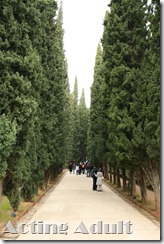

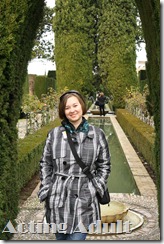


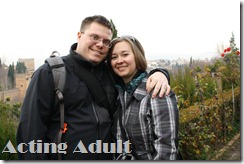
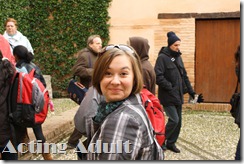


The gardens were beautiful even in the winter. You can’t tell, but we were kind of cold that day! It was almost 40 degrees and kind of windy. We were all glad to head to the big palaces. The Alhambra complex is actually made of three different palaces, but I took most pictures at two. The first was the less impressive and smaller side palace.

This was the main entrance into the fortified castle area.

What a view of the city beyond!

This was one of the bigger rooms in the smaller palace. This would have been the home of the justice system of the kingdom.
We headed into the main palace next, which is where the classic views of the Alhambra are found. This is what you think of when you think of the Alhambra. There were so many details! What follows is a stream of consciousness based on the upload of the pictures. :)
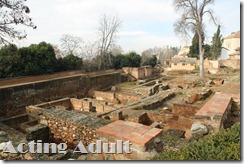
Next to the main palace were these ruins. There was a story of the sultana (queen) who had an affair with a man in the sultan’s court. When the sultan found out, he had the man and his entire family killed, and their house burned to the ground. Legend has it that these are their ruins.

Farther down on the tour, we were told this tree was supposedly the only witness to the sultana’s love affair. It’s dead now but still stands as a reminder of the legend.

Even the ceilings are beautiful – this is the original wood ceiling in one of the rooms of the palace.

All the palaces have decoration on the wall. It’s pressed plaster and has either wording or geometric designs on it, per the Muslim tradition of not creating art with images of people.
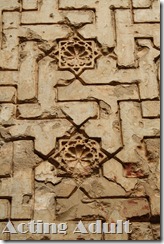
This is one of the detail shots from the hallway in the picture above.
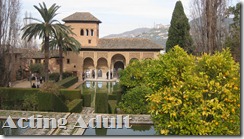
We were going to head in there and find some beautiful scenery!

When the Moors lived here, these fountains would not have had moving water; instead, it would have been a still pool.
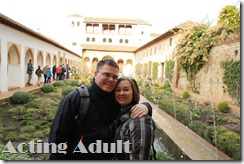
In that same courtyard, we had to get a picture.

I spent most of the trip trying to capture the place on video, while Husband was taking pictures. I think we both got some good material!

The palace was made up of many courtyards. The culture was to live inside their fortified walls but they wanted to bring the outside in. So there was no ceiling to the courtyards, they brought water and plants inside and lived entirely in those various courtyards. There are some inside rooms but not many.
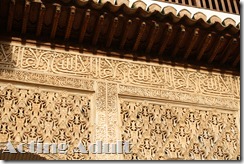
You can see the wooden top on the wall and that was to keep some of the rain from coming into the courtyard. That is original to the 1300s.

Most of the columns that supported the palace had decorations of the pressed plaster as well.

Every time you turn a corner, there is something even more beautiful to look at. The way that the light plays in the stained glass and the doorways were amazing.

This is the classic view of the palace at the Alhambra, with the reflecting pool. It’s similar to the Taj Mahal in its design (one inspired the other, but I can’t remember which way it is!)

Opposite the view above, these columns lead inside to various rooms for the family and court.

In the sultan’s receiving room, this is the ceiling. It’s basically a 3D mosaic made up of hundreds of small pieces put together to make the design.
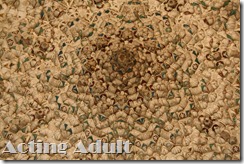
This is a closer view. It is spectacular in person.

On most walls in the palace, there are a few different types of decorations. There is the pressed plaster in the middle that usually has some kind of Arabic script from the Koran, plus the tile work below.
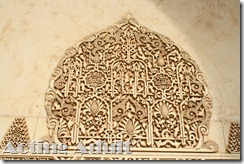
Here are more detail shots of the pressed plaster.

There is amazing detail!

I would love to have something like this in my house. :)

This is the opposite side to the classic reflecting pool image.

Random mosaics are everywhere.

Even the doors have intricate designs!

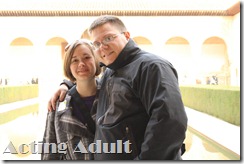
Unfortunately, we couldn’t get the exposure quite right for this shot, but you get the idea. :) Everyone has a picture in front of this reflecting pool!
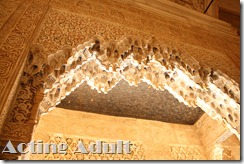

Here is more of the mosaic work in the ceiling, this time in the sultana’s bedroom. Not only is in the middle of the ceiling, but it decorates the archways into the room.
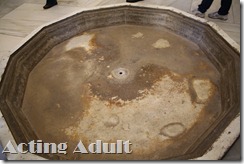
Remember the legend of the sultana and her lover? Supposedly the rain stain in this pool in her bedrooms is where the lady and her lover were killed by the sultan’s men.

At the end of our palace tour, there was a final glimpse of a pretty fountain. Water was everywhere in the palace and just set the right mood for the tour. So pretty!
Part of our tour included lunch at the Hotel Guadalupe across the street from the palace. We ate and then were serenaded by Spainish guitarists! Of course, we had to buy a CD from the university students. Not sure if three guitars equals more passion or not.

After lunch, we bussed to the center of town for a walk about. There wasn’t a lot of time to shop and most were closed anyway. We snacked on hot chocolate and churros at a coffee shop and quite enjoyed our time in Granada!

Back on the bus and home late. Touring is tiring.

%5B4%5D.jpg "9. Wed, Dec 29, 2010 - Nerja, Spain (60)")
%5B3%5D.jpg "9. Wed, Dec 29, 2010 - Nerja, Spain (58)")
%5B3%5D.jpg "9. Wed, Dec 29, 2010 - Nerja, Spain (71)")
%5B3%5D.jpg "9. Wed, Dec 29, 2010 - Nerja, Spain (72)")
%5B3%5D.jpg "9. Wed, Dec 29, 2010 - Nerja, Spain (66)")
%5B3%5D.jpg "9. Wed, Dec 29, 2010 - Nerja, Spain (65)")
%5B3%5D.jpg "9. Wed, Dec 29, 2010 - Nerja, Spain (67)")
%5B3%5D.jpg "9. Wed, Dec 29, 2010 - Nerja, Spain (87)")
%5B3%5D.jpg "9. Wed, Dec 29, 2010 - Nerja, Spain (88)")
%5B3%5D.jpg "9. Wed, Dec 29, 2010 - Nerja, Spain (62)")
%5B3%5D.jpg "9. Wed, Dec 29, 2010 - Nerja, Spain (74)")
%5B3%5D.jpg "9. Wed, Dec 29, 2010 - Nerja, Spain (75)")
%5B3%5D.jpg "9. Wed, Dec 29, 2010 - Nerja, Spain (76)")
%5B3%5D.jpg "9. Wed, Dec 29, 2010 - Nerja, Spain (77)")
%5B3%5D.jpg "9. Wed, Dec 29, 2010 - Nerja, Spain (78)")
%5B3%5D.jpg "9. Wed, Dec 29, 2010 - Nerja, Spain (79)")
%5B3%5D.jpg "9. Wed, Dec 29, 2010 - Nerja, Spain (81)")
%5B3%5D.jpg "9. Wed, Dec 29, 2010 - Nerja, Spain (94)")
%5B3%5D.jpg "9. Wed, Dec 29, 2010 - Nerja, Spain (95)")
%5B3%5D.jpg "9. Wed, Dec 29, 2010 - Nerja, Spain (99)")
%5B3%5D.jpg "9. Wed, Dec 29, 2010 - Nerja, Spain (102)")
%5B3%5D.jpg "9. Wed, Dec 29, 2010 - Nerja, Spain (103)")
%5B3%5D.jpg "9. Wed, Dec 29, 2010 - Nerja, Spain (104)")
%5B3%5D.jpg "9. Wed, Dec 29, 2010 - Nerja, Spain (107)")
%5B3%5D.jpg "9. Wed, Dec 29, 2010 - Nerja, Spain (53)")
%5B3%5D.jpg "9. Wed, Dec 29, 2010 - Nerja, Spain (54)")
%5B3%5D.jpg "9. Wed, Dec 29, 2010 - Nerja, Spain (55)")
%5B3%5D.jpg "9. Wed, Dec 29, 2010 - Nerja, Spain (56)")
%5B3%5D.jpg "9. Wed, Dec 29, 2010 - Nerja, Spain (68)")
%5B3%5D.jpg "9. Wed, Dec 29, 2010 - Nerja, Spain (85)")


%5B7%5D.jpg "C. Main palace (39)")
%5B3%5D.jpg "A. Summer palace (46)")
%5B3%5D.jpg "A. Summer palace (47)")
%5B3%5D.jpg "A. Summer palace (50)")
%5B3%5D.jpg "A. Summer palace (52)")
%5B3%5D.jpg "A. Summer palace (54)")
%5B3%5D.jpg "A. Summer palace (55)")
%5B3%5D.jpg "A. Summer palace (65)")
%5B3%5D.jpg "A. Summer palace (82)")

%5B5%5D.jpg "A. Summer palace (43)")
%5B3%5D.jpg "A. Summer palace (44)")
%5B3%5D.jpg "C. Main palace (51)")
%5B3%5D.jpg "A. Summer palace (40)")
%5B3%5D.jpg "A. Summer Palace (26)")
%5B3%5D.jpg "C. Main palace (45)")
%5B6%5D.jpg "C. Main palace (49)")
%5B3%5D.jpg "C. Main palace (50)")
%5B3%5D.jpg "A. Summer Palace (32)")
%5B3%5D.jpg "A. Summer Palace (13)")
%5B3%5D.jpg "A. Summer palace (64)")
%5B3%5D.jpg "A. Summer palace (66)")
%5B3%5D.jpg "A. Summer palace (69)")
%5B3%5D.jpg "A. Summer palace (70)")
%5B3%5D.jpg "A. Summer palace (71)")
%5B3%5D.jpg "A. Summer palace (73)")
%5B3%5D.jpg "C. Main palace (28)")
%5B3%5D.jpg "C. Main palace (30)")
%5B3%5D.jpg "C. Main palace (43)")
%5B3%5D.jpg "C. Main palace (44)")
%5B3%5D.jpg "C. Main palace (53)")
%5B3%5D.jpg "C. Main palace (73)")
%5B3%5D.jpg "C. Main palace (74)")
%5B3%5D.jpg "C. Main palace (75)")
%5B3%5D.jpg "C. Main palace (76)")
%5B3%5D.jpg "C. Main palace (84)")
%5B3%5D.jpg "C. Main palace (90)")
%5B3%5D.jpg "C. Main palace (92)")
%5B3%5D.jpg "C. Main palace (95)")
%5B3%5D.jpg "C. Main palace (97)")
%5B3%5D.jpg "C. Main palace (100)")
%5B3%5D.jpg "C. Main palace (111)")
%5B3%5D.jpg "C. Main palace (1)")
%5B3%5D.jpg "D. Granada (4)")
%5B3%5D.jpg "D. Granada (6)")